October 18, 2026
Affordable Prescription Glasses Without Insurance: A Buying Guide
You might think affordable prescription glasses are hard to find because retail prices of eyeglasses can amount to hundreds of dollars and sometimes go over the thousand mark. However, there are numerous ways to get prescription glasses at affordable rates if you know what options are available to you.
Even folks who have insurance are typically only covered for a portion of the expense, with limits set on how much insurance will cover and sometimes a certain discount on the remaining balance. Therefore, whether you have insurance or not, learning how to find affordable prescription glasses can save you hundreds of dollars.
 The optical marketplace has changed dramatically over the last few years, with health insurance alternatives providing discounts on prescription eyecare and exams. This is an important transformation, as there is now a collaborative recognition that no one should have to worry about how they're going to pay for a tool that will help them perform daily activities like reading a book, looking at a screen, or driving safely at night.
This comprehensive guide is designed to help you understand the true cost of glasses without insurance, explore non-traditional safety-net and discount options, compare reliable direct-to-consumer online alternatives, and use federal consumer protections to secure high-quality no insurance glasses for a fraction of traditional dispensary prices.
Cost of Prescription Glasses Without Insurance
If you walk into a traditional private optometry practice or high-end mall optical boutique, you might experience immediate sticker shock. Across the United States, the out-of-pocket cash price for a complete pair of prescription glasses without insurance averages $150 to $450+ for standard single-vision lenses, and can easily surge past $600 to $1,000 for high-index progressive lenses or complex prescriptions.
You should first understand what affects the cost of glasses so you have a better understanding before you shop.
 ### Frames vs. Lenses: Where Does Your Money Actually Go?
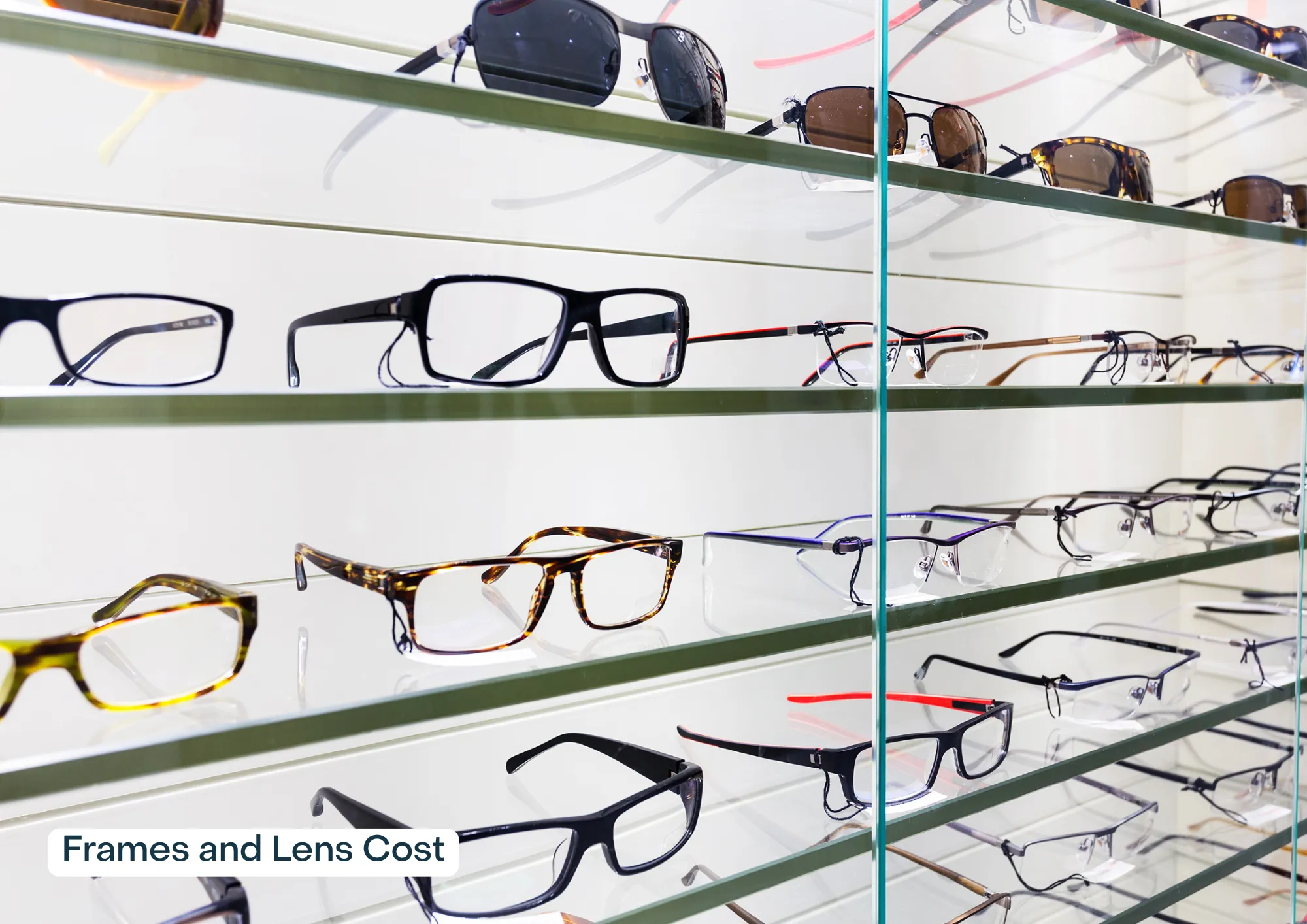
If you've never purchased eyeglasses before, you need to know that your eyeglass frames and your eyeglass lenses are priced separately. And you will see that the two are priced out on separate lines on your bill. How you choose each part will heavily affect your final price.
Designer Frame Markups & Optical Monopoly Dynamics
Much of the global eyewear market is heavily concentrated among a small number of international manufacturing conglomerates, such as EssilorLuxottica, Safilo, and Marchon. These parent companies design, produce, and distribute hundreds of well-known designer fashion labels under license.
A basic designer metal or acetate frame that costs just $10 to $20 to manufacture in wholesale batches often ends up with a retail sticker price between $200 and $450 or more if you choose a designer label.
 - CR-39 Standard Plastic is the baseline material for low prescriptions. It is optically clear and inexpensive, but thicker and prone to scratching without treatments.
- Polycarbonate & Trivex are impact-resistant materials ideal for children, sports, and rimless frames. Lighter than standard plastic, though slightly prone to chromatic aberration in strong prescriptions, and $40 – $90+.
- High-Index 1.67 & 1.74 are dense optical resins that bend light more efficiently, resulting in thinner, lighter lenses for moderate-to-severe refractive errors (e.g., above -4.00D or +3.00D). This can add on $80 – $180+.
- Anti-Reflective (AR), Scratch-Resistant & UV Coatings are crucial for reducing night glare and screen reflections, yet traditionally billed as separate à la carte upgrades. This can add $ 30 – $120+.
- Photochromic / Transitions are lenses that automatically darken when exposed to ultraviolet sunlight and return to clear indoors. This can add on $70 – $140+.
Out-of-Pocket Cost Comparison Matrix
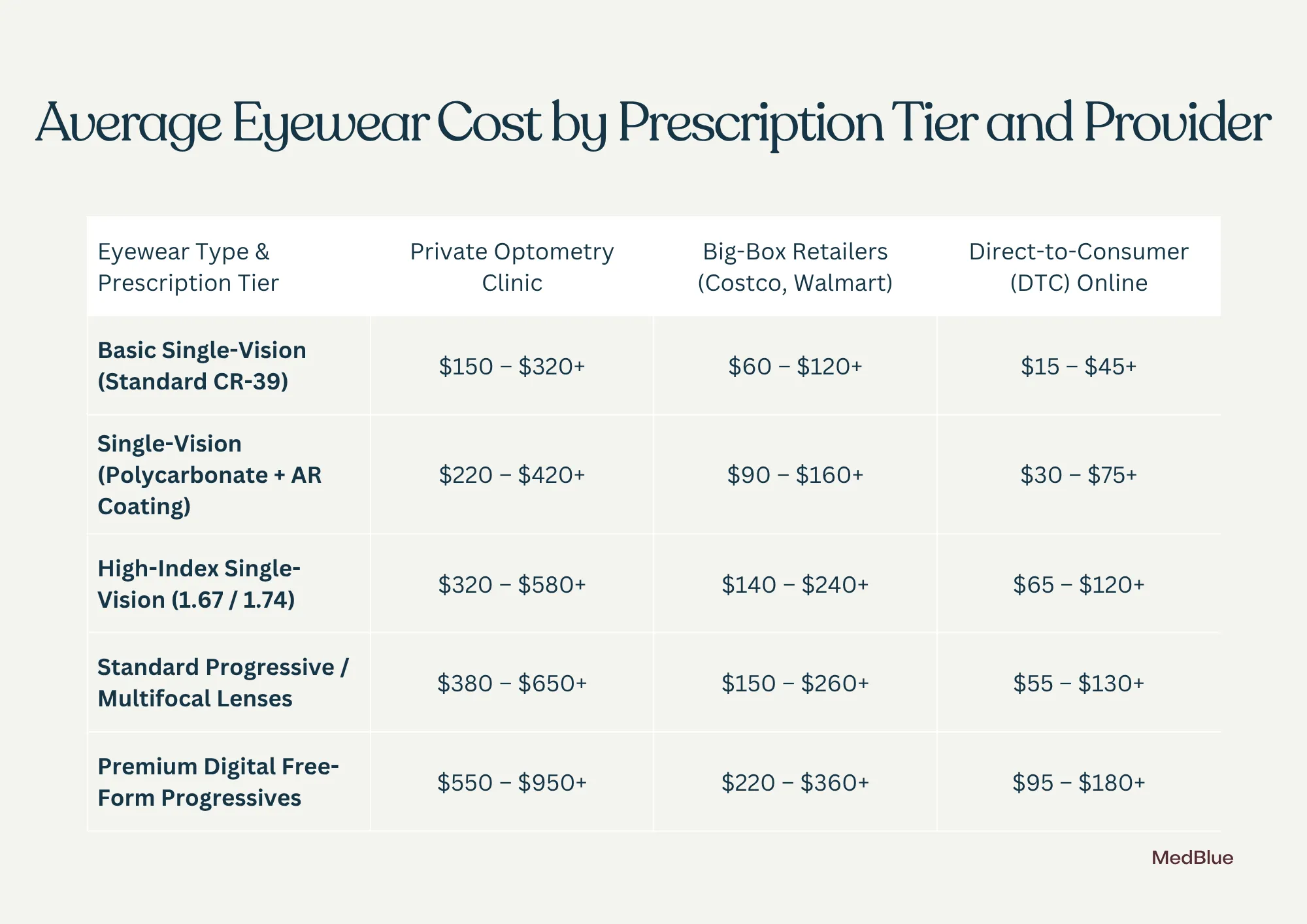
To give you a clear baseline, here is how average out-of-pocket costs compare across major purchasing channels.
Alternative Ways to Pay
If you do not have employer-sponsored vision benefits, you do not have to shoulder retail prices alone. Several alternative funding models, community programs, and discount networks can reduce your costs.
Health Discount Plan Organizations with Vision Care
Discount Plan Organizations (DPO) like MedBlue provide discounts on eye exams and eyeglass prescriptions when you join the health plan. A DPO is a health insurance alternative and provides discounts on a variety of healthcare needs in addition to vision care. Those healthcare needs can include discounts on doctor visits, dentist visits, X-rays, MRIs, prescription drugs, and telehealth. Instead of getting a discount on one area of your healthcare needs, they provide comprehensive discounts on many healthcare needs. Costs start at $40 monthly.
Vision Discount Health Plans
Many people confuse vision insurance with vision discount plans, but they operate very differently. Vision insurance involves monthly premiums, annual deductibles, claim filings, and strict network caps. Vision discount plans, on the other hand, are membership-based discount agreements.
For a membership fee, discount programs provide immediate access to pre-negotiated wholesale rates across nationwide retail and independent provider networks that reduce cash pay costs. An average cost can start at $15.
If you are already an AARP or AAA member, check your existing benefits, as many include automatic vision discount perks at major optical chains like LensCrafters, Target Optical, and Pearle Vision.
Healthcare Sharing Ministries
Healthcare Sharing Ministries (HCSMs) are mainly faith-based non-profit cooperatives where members share eligible medical expenses.
Vision Care Sharing Guidelines
Because HCSMs are not traditional health insurance, their optical coverage guidelines operate under specific bylaws. Members pay a membership fee and, with that fee, are given discount access to healthcare services.
Routine vs. Medical Eye Care: Routine eye exams and standard eyeglass purchases are generally categorized as routine preventive maintenance and are often paid out of pocket by members unless an optional vision/dental add-on program is selected.
- Medical Eye Conditions: Serious ocular conditions, accidents resulting in eye trauma, cataracts, and diabetic retinopathy evaluations are typically eligible for community cost-sharing after meeting your Personal Responsibility Amount (PRA) or Annual Unshareable Amount (AUA).
- Itemized Receipt Submission: When an optical expense qualifies under your ministry's guidelines, request an itemized HCFA/CMS-1500 form or detailed receipt with diagnostic (ICD-10) and procedure (CPT) codes from your eye doctor to submit for community sharing.
Federally-Funded, Non-Profit & Community Vision Assistance Programs
For individuals and families facing severe financial distress, federally funded organizations help to make sure everyone has access to clear eyesight.
Federally Qualified Health Centers (FQHCs) & Sliding-Fee Scales
Federally Qualified Health Centers (FQHCs) receive federal grant support under Section 330 of the Public Health Service Act to deliver comprehensive primary and preventive care to underserved communities.
- Sliding-Fee Schedule: Services and basic corrective eyeglasses are priced strictly according to your household income relative to the Federal Poverty Guidelines (FPG). If your income falls below 100% of the FPG, an exam and basic glasses may cost a nominal fee of $10 to $25.
Charities
If you are experiencing significant financial difficulty and need glasses, there are charity organizations that can help you. They can provide prescription eyeglasses for a reduced fee. You will need to share information like your household income to qualify. Charities that provide this type of service include Lions International, New Eyes for the Needy, OneSight EssilorLuxottica Foundation, and VSP Eyes of Hope.
 Direct-to-Consumer Online Eyeglasses
The single most effective way to secure high-quality, affordable glasses without insurance is purchasing directly from online optical labs. By removing commercial retail rents, showroom commissions, and licensing markups, online dispensaries deliver custom-crafted prescription eyewear for a fraction of traditional costs. However, before you can do that, you need to have an eye exam, which will give you the information you need to buy glasses online.
What Information You Need to Buy Glasses Online
Ordering glasses online is straightforward once you have the exact clinical measurements from your prescription. You should first get an eye exam and ask for the prescription. They are legally obligated to provide you with the prescription whether you choose to purchase a prescription through their eyeglasses provider or not. The prescription will include your Pupillary Distance (PD), which measures the distance between the centers of your pupils. This measurement is important so the optical center of each lens aligns perfectly with your visual axis.
- Single PD (Binocular): One number (typically between 54 mm and 72 mm for adults) representing total pupil-to-pupil distance.
- Dual PD (Monocular): Two numbers written like 31/32, measuring the distance from each pupil center to the bridge of your nose. Dual PD provides superior accuracy for strong prescriptions and progressive lenses.
- Measuring at Home: Stand 8 inches from a mirror, hold a millimeter ruler flat against your browline, align zero with your right pupil, and read the millimeter mark directly over your left pupil. Many online retailers also provide accurate, secure digital webcam tools to capture this measurement.
Frame Sizing Specs: Lens Width, Bridge Width, and Temple Length
Take a look at the inside temple arm of any comfortable pair of glasses you currently own. You will see a series of three numbers stamped on the frame, and let's use the example of 52 18 140.
Lens Width: 52 mm
Bridge Width: 18 mm
Temple Length: 140 mm
The lens width is the width of one lens, the bridge width is the gap over your nose, and the temple length is representative of the length from the front of the arm of your eyeglasses to the ear. When you're browsing online catalogs, filter frames within 1 to 2 millimeters of your existing dimensions to ensure an ideal, comfortable fit on your face.
 ### When to Order Online vs. When to Visit a Physical Dispensary
While online ordering offers unmatched value, certain complex prescriptions still benefit from an in-person optician fitting. If you have a fairly standard prescription, then online prescriptions work, but if your prescription is more complex, then you might need to stick to an in-person dispensary.
- Ideal for Online Ordering: Mild to moderate single-vision distance or reading prescriptions (Sphere between -4.00D and +3.00D, Cylinder under 2.00D), backup glasses, computer blue-light glasses, and prescription sunglasses.
- When to Consider In-Person Dispensaries: Very high prescriptions (Sphere > +/-6.00D), high astigmatism correction, prism corrections for double vision (diplopia), or complex progressive lenses where vertical fitting heights (Segment Height) must be marked by hand while the frame sits on your face.
Big-Box Retailers & Optical Chains
If you prefer to try on frames in person or have an optician personally adjust your glasses, big-box retailers offer a balanced middle ground between online pricing and boutique costs.
Warehouse Club Optical Centers
Warehouse clubs like Costco consistently rank highest in consumer satisfaction for brick-and-mortar optical value.
- Included Upgrades: Unlike independent boutiques that charge extra for every lens feature, warehouse clubs often package impact-resistant polycarbonate lenses and premium anti-reflective coatings into their standard lens prices ($60 to $90 for lenses).
- Membership Flexibility: You typically do not need a paid membership to be examined by the independent Doctor of Optometry inside a warehouse club, though you will need an active membership (or a member to accompany you) to purchase frames and lenses at the optical counter.
Promotional Bundle Retailers
High-volume retail chains frequently run promotional offers.
- Understanding the Fine Print: These promotional packages are based on select budget frame racks and basic plastic (CR-39) single-vision lenses. If you require high-index thinning, anti-reflective coatings, or progressive lenses, the retailer will add upgrade fees. Clarify your total cost before placing the final order.
Department Superstores
Big department stores like Walmart have vision care centers, and they often provide cheap glasses options.
- Budget Racks: Frame selections starting between $9 and $38.
- Some Include Free Lifetime Service: Complimentary in-person frame adjustments, nose-pad replacements, and screw tightening, regardless of where your glasses were originally purchased.
The FTC Eyeglass Rule
When managing vision care without insurance, knowing your legal rights as a consumer protects you from being overcharged or pressured into buying retail hardware.
Mandatory Prescription Release Without Extra Fees
Under the Federal Trade Commission (FTC) Eyeglass Rule (16 CFR Part 456), your eye doctor is legally obligated to hand you a clear, signed, and complete copy of your eyeglass prescription immediately upon completion of your examination.
- The doctor cannot charge you an extra fee for your prescription copy.
- The doctor cannot require you to buy frames, lenses, or contact lenses from their office as a condition of receiving your prescription.
- The doctor cannot require you to sign a liability waiver in exchange for your prescription.
Requesting Your Pupillary Distance (PD)
While federal law requires immediate release of the optical prescription (Sphere, Cylinder, Axis, and Add power), Pupillary Distance (PD) is considered an optical dispensing measurement in some states.
- Proactive Tip: When the technician or doctor places the digital pupilometer or pupil ruler on your face during the exam, kindly ask: "Could you please write my measured pupillary distance on my paper prescription?" Most optometrists are happy to include it when asked courteously during the clinical encounter.
Prescription Expiration Rules & Recheck Policies
Once you get an eye exam and have your prescription in hand, you can go ahead and get your prescription glasses. But your prescription is only valid for a limited time.
- Prescription Validity: Eyeglass prescriptions are generally valid for 1 to 2 years depending on state optometric regulations.
- Prescription Rechecks: If you order new glasses and experience headaches, eye strain, or persistent blurriness, reputable optical practices and online labs provide a 30- to 60-day prescription recheck window. Your examining doctor can re-verify the refraction at no charge to ensure the laboratory manufactured the lenses to the exact clinical specifications.
How to Get Affordable Glasses
By strategically uncoupling your clinical exam from your eyewear hardware purchase, you can comfortably secure a brand-new, complete pair of affordable glasses for a reasonable rate.
Complete an Affordable Cash-Pay Exam
Book an exam at an independent optometrist located inside Costco, Sam's Club, or a university optometry school clinic.
Collect Your Paper Prescription with PD
Ensure your Sphere, Cylinder, Axis, and Pupillary Distance are legibly recorded on your physical prescription copy before leaving the clinic.
Order Online
Enter your prescription details into a reputable online lab. Select a durable acetate or stainless-steel frame, single-vision lenses, and include standard anti-reflective coating.
Pay Using Pre-Tax HSA or FSA Dollars
Use your Health Savings Account or Flexible Spending Account debit card. Because optical hardware is 100% IRS-qualified, you save an additional 20% to 30% based on your individual tax bracket.
Learn About MedBlue Affordable Eyeglasses Prescriptions
MedBlue includes vision care in its discount health plan. You pay a monthly fee as low as $40 or an annual fee and get access to discount eye exams and affordable prescription glasses. In addition to vision care, the plan gives you access to discounts on doctor visits, prescriptions, diagnostics, and imaging, among other care. If you want to learn more about the MedBlue plan, review the plan pricing page, or connect with a member of our friendly customer care team.
FAQs
Can I buy prescription glasses online with an expired prescription?
No. Under federal regulations, optical dispensaries and online retailers are legally required to verify that your prescription is current and unexpired before custom-grinding corrective lenses. If your prescription has expired, you will need a brief, low-cost refraction exam to renew your documentation before placing an order.
Are cheap online prescription glasses as durable as designer glasses?
Yes. The optical materials used in modern online laboratories (CR-39, polycarbonate, high-index resins) meet the exact same ANSI (American National Standards Institute) impact-resistance and optical clarity tolerances as lenses sold in luxury boutiques. The primary differences lie in brand name licensing, designer emblems, and ornate temple hinges—not refractive visual precision.
Can I put new prescription lenses into my old frames to save money?
Yes. If you already own a comfortable, high-quality frame that fits your face well, you can use a direct relensing service (such as Lensabl, Overnight Glasses, or local optical labs). You mail in your existing frame, and the technicians custom-cut and install fresh lenses according to your new prescription, saving you the expense of buying new frames.
Will Original Medicare cover my prescription glasses?
Original Medicare (Part A and Part B) does not cover routine vision exams or standard prescription eyeglasses. However, there is one key exception: Medicare Part B will cover one pair of standard corrective eyeglasses or contact lenses following cataract surgery that implants an intraocular lens (IOL). If you have a Medicare Advantage (Part C) plan, review your plan documents, as many include supplemental routine vision and hardware allowances.
Can I use HSA or FSA funds for prescription glasses without insurance?
You can use HSA or FSA funds for prescription glasses without insurance. Prescription eyeglasses, prescription sunglasses, bifocals, reading glasses, contact lenses, lens cleaning solutions, and eye exams are all 100% IRS-qualified medical expenses. You can use your HSA or FSA debit card directly at checkout online or in-store, or submit your itemized receipt for tax-free reimbursement.