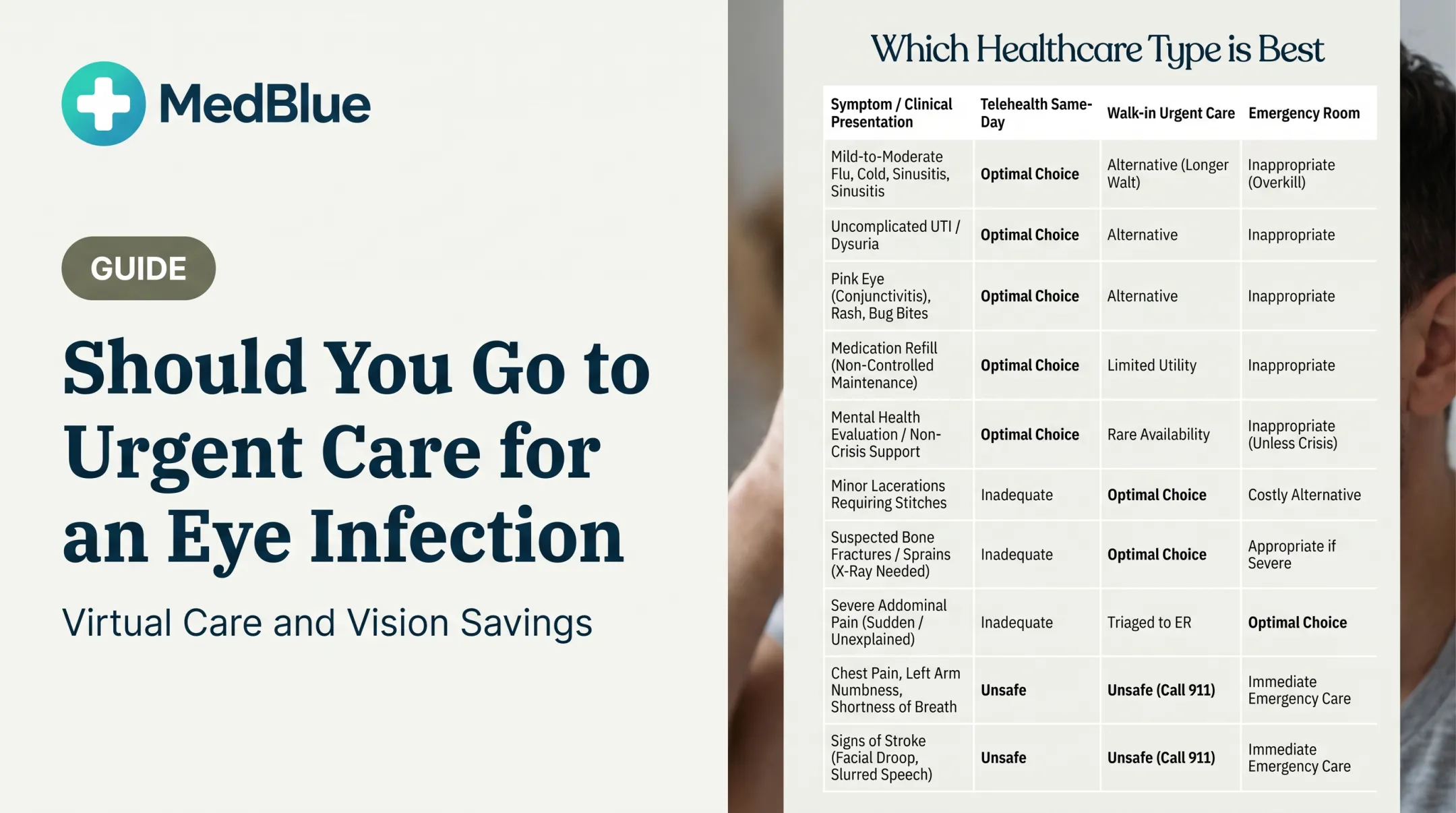

This guide covers when home care is reasonable, when urgent care is the right call, and which symptoms mean you should call 911 or go to the emergency department.
Key Takeaways
- Go to urgent care for a new, worsening, painful, spreading, persistent, or possibly infected rash with no emergency signs.
- Seek emergency care for trouble breathing, throat or facial swelling, widespread blistering or peeling, confusion, or faintness.
- Mild, localized rashes without fever, severe pain, or rapid spread can often be watched at home.
- A photo and symptom timeline help a clinician, but appearance alone can't confirm the cause.
When to Go to Urgent Care for a Rash
Urgent care suits problems that need same-day attention but don't threaten breathing, circulation, consciousness, or major organ function. The Urgent Care Association describes it as care for non-life-threatening conditions. Clinicians there routinely handle poison ivy, insect bites, and skin infections.
Signs the rash needs prompt evaluation
Go when the rash is:
- Changing quickly or spreading
- Very itchy or painful
- Covering a large area
- Getting in the way of sleep, work, or daily activities
The American Academy of Dermatology also lists a rash over most of the body, blisters, open sores, and fever as reasons to seek care.
Symptoms that suggest infection
A rash with any of these should be looked at the same day:
- Fever or chills
- Warmth, swelling, or tenderness in the area
- Drainage or crusting
- Redness that keeps expanding
The CDC notes that cellulitis (a bacterial skin infection) can be painful, red, swollen, and warm, and that fast-spreading redness or fever calls for immediate attention.
New exposures and medications
See a clinician if the rash followed a new medication, product, food, plant, or insect bite and the cause is unclear, widespread, or worsening. Don't stop a prescribed medicine on your own. Talk to the prescriber first, unless emergency personnel tell you otherwise.
Higher-risk situations
Use a lower threshold for calling a clinician if the rash affects:
- An infant or young child, especially with fever
- A pregnant person
- An older adult
- Someone who is immunocompromised
Shingles is one example. The CDC advises contacting a clinician promptly if it's suspected, since age and weakened immunity raise the risk of complications.
When a Rash Requires Emergency Care
Call 911 or go to the ER. Urgent care is not a substitute here.
Possible severe allergic reaction
A rash with any of these points to anaphylaxis:
- Trouble breathing, wheezing, or throat tightness
- Difficulty swallowing or hoarseness
- Swelling of the lips, tongue, face, or around the eyes
- Dizziness, fainting, or a weak pulse
Hives alone are not anaphylaxis. The difference is whole-body symptoms and changes in breathing or circulation, not how the rash looks. Symptoms can progress fast, and not every one has to be present.
Other emergency warning signs
- Widespread blisters or peeling skin, severe skin pain, or sores in the eyes, mouth, nose, or genitals (possible Stevens-Johnson syndrome or toxic epidermal necrolysis, both life-threatening)
- Rapidly spreading purple, dark, or black areas with fever, severe pain, weakness, or confusion (possible necrotizing infection or meningococcal disease; CDC treats both as emergencies)
- A racing heartbeat, confusion, or faintness alongside a worsening rash.

If you feel faint, confused, or short of breath, don't drive yourself. Call 911.
How to Think About Possible Rash Causes
Allergic, viral, bacterial, fungal, medication-related, irritant, and autoimmune rashes can overlap in appearance. Use symptoms, timing, exposures, and progression as clues. Don't try to diagnose from a photo.
Common patterns, with caveats
| Pattern | Typical clues |
|---|---|
| Hives (allergic) | Raised, itchy welts that change shape or move; each usually fades within 24 hours |
| Viral rash | Often less itchy; may come with fever, fatigue, or respiratory symptoms |
| Bacterial infection | Warmth, tenderness, drainage, honey-colored crusts |
| Ringworm (fungal) | Circular, scaly, itchy patch |
| Shingles | Painful, stripe-like band on one side of the body |
These are clues, not answers. Infections can even trigger hives.
Medication rashes
A rash after starting or changing a medicine deserves prompt medical advice. Go sooner if it spreads or comes with fever, facial swelling, blisters, peeling, or mouth or eye sores. The FDA has warned about a rare, serious reaction (DRESS) to certain antiseizure medicines, marked by rash, fever, and swollen lymph nodes.
Darker skin tones
Redness can be harder to see on darker skin, and many conditions look different across skin tones. Report changes in warmth, texture, swelling, tenderness, bruising, and discoloration, plus how you feel overall.
What Urgent Care Can Do for a Rash
A clinician will typically review:
- Onset, location, and pattern of the rash
- Recent exposures, medications, and allergies
- Other symptoms you may have
They'll examine the rash, check vital signs, and may order a limited test such as a skin swab. Available tests vary by center.
Treatment depends on the diagnosis and may include:
- Symptom relief, such as cool compresses
- Antihistamines for itch
- Topical creams
- Antifungals for ringworm
- Antibiotics for bacterial infection
- Referral to a specialist or the ER if needed
Virtual care for mild rashes
For a mild, visible rash with no warning signs, virtual care can be a practical first step. A 2023 meta-analysis in BMJ Open found 68.9% diagnostic agreement for teledermatology across studied settings. That figure is useful context, though it does not guarantee accuracy for every rash.

Eligible MedBlue members may be able to use 24/7 virtual urgent care for initial guidance and triage, subject to plan terms and service availability. Digital triage typically collects symptoms, onset date, allergies, medications, and clear photos.
Virtual care is not appropriate for breathing difficulty, severe swelling, blistering, confusion, or any other emergency.
What to Do at Home and How to Prepare
Home care for a mild rash
If the rash is small and stable, with no fever, severe pain, blisters, open sores, or rapid spread:
- Apply cool, wet compresses
- Avoid suspected irritants
- Use a fragrance-free moisturizer if skin is dry
- Follow product directions exactly, and ask a pharmacist before using medicated creams
Over-the-counter hydrocortisone labels typically say to stop and ask a doctor if the rash worsens or persists, and to ask first for children under 2.
Track the rash
Note the size, color, texture, pain, itch, warmth, and drainage each day. Photograph it in good natural light, avoiding shadows and glare, with both a close-up and a wider shot, as the AAD recommends.

Before your visit
Gather:
- The start date and how the rash has changed
- Recent medications and supplements
- New foods, products, travel, outdoor exposures, or insect bites
- Allergies, medical conditions, and prior skin problems
If the rash could be contagious, avoid sharing towels or close skin contact until it's evaluated.
Frequently Asked Questions
Can I go to urgent care for a rash?
Yes, for a new, worsening, painful, spreading, persistent, or possibly infected rash without emergency symptoms. If you have breathing problems, severe swelling, blistering, confusion, or faintness, go to the ER.
What will urgent care do about a rash?
A clinician takes your history, examines the skin, and may run basic tests. You may receive symptom relief or a prescription, or a referral if the rash looks more serious.
How can I tell if a rash is caused by a virus or an allergic reaction?
Hives are usually itchy, raised, and move around, often after an exposure. Viral rashes may come with fever or illness symptoms. These features overlap, so a clinician may be needed.
When should I go to the emergency room for a rash?
Go for trouble breathing, facial or throat swelling, widespread blistering or peeling, sores in the mouth or eyes, purple or black skin, severe pain, confusion, or fainting.
Can I treat a mild rash at home?
Often, yes, with cool compresses and avoiding irritants. Get evaluated if it spreads quickly or brings fever, pain, swelling, blisters, drainage, or no improvement.
What should I bring to an urgent care visit for a rash?
Bring a symptom timeline, medication and allergy lists, exposure details, relevant history, and clear photos showing how the rash changed.